
What Jewell County Probate Covers
Jewell County probate matters are handled in District Court through the Probate Division of District Court concept in the state court map. Kansas does not place Jewell County probate in a separate elected probate court. The same District Court system that handles civil, criminal, domestic, juvenile, traffic, small claims, and other state cases also handles estate and fiduciary cases.
Probate records can include wills offered for probate, petitions, notices to creditors, orders admitting a will, letters testamentary, letters of administration, inventories, accountings, claims, real estate orders, guardianship and conservatorship petitions, annual reports, and final settlement orders. Some matters are simple. Others need hearings, notices, creditor handling, property orders, or ongoing court oversight.
When a probate file overlaps with divorce, land, or civil records, use the court case path for court orders and the correct county office for noncourt records. For example, a deed or recorded land instrument routes to the Register of Deeds, while the estate order authorizing a sale or transfer is a court record. For family-status records, Jewell County marriage and divorce records use different certificate and case-file channels.
Probate Terms Defined
Probate filings use short legal terms that can be hard to read without context. These definitions reflect common court usage and help identify what type of Jewell County probate record is being searched.
- Testator
- A person who made a will.
- Executor
- A person named in a will to carry out estate duties after appointment by the court.
- Administrator
- A person appointed to handle an estate when there is no executor or no valid will appointment.
- Intestate
- Dying without a valid will, so property passes under Kansas law.
- Guardianship
- A court case about care and personal decisions for a minor or adult who needs a guardian.
- Conservatorship
- A court case about management of money or property for a person who needs a conservator.
How to Search Jewell County Probate Records
Start with Kansas Case Search for public probate case entries if the matter is in the statewide system and public. Search by party name, case number, business name, or other available criteria. For probate, names may include the estate caption, decedent, petitioner, fiduciary, guardian, conservator, or interested party. The live portal was not fully inspectable during research, so use the official search descriptions and the court's own result labels.
- Search Kansas Case Search by case number if a filing, notice, or court paper already lists one.
- If there is no case number, search the decedent, ward, conservatee, petitioner, executor, administrator, guardian, or conservator name.
- Review the result for county, case type, filing date, status, docket entries, hearings, and public documents.
- If no record appears, contact the Jewell County Clerk of the District Court because older or non-digitized probate files may require a courthouse terminal or clerk search.
- Ask the clerk for plain copies, certified copies, letters, or orders, and confirm the fee before sending payment.
Note: A missing online result does not prove that no estate or guardianship file exists.
Jewell County Probate Court Contact
The official local probate venue is Jewell County District Court. The Kansas Judicial Branch identifies the Jewell County court in the 12th Judicial District and lists Magistrate Judge Kevin L. Phillips and Clerk of the Court Myriah Wanklyn on the county courthouse page. Use this contact for estate filings, guardianship and conservatorship case questions, courthouse terminal access, and certified court documents.
Jewell County Probate Division of District Court
Jewell County Courthouse
307 N Commercial, Suite 9
Mankato, KS 66956
785-378-4030
Fax: 785-378-4035
8:30 a.m.-noon and 1:00 p.m.-4:30 p.m.; courthouse access closes 12:30 p.m. Fridays
Jewell County Probate Filing Fees
No Jewell-specific probate fee table was located in the official county sources reviewed. The research did capture Kansas official probate fee examples, and those should be confirmed with the Jewell County clerk before filing. Court copy and certification fees come from Kansas Judicial Branch records-request guidance unless the clerk quotes a local variation for a specific request.
| Item | Amount |
|---|---|
| Probate of estate or will | $131.50, statewide example to confirm locally |
| Determination of descent | $71.50, statewide example to confirm locally |
| Filing will and affidavit | $70.50, statewide example to confirm locally |
| Guardianship or conservatorship | $91.50, statewide example to confirm locally |
| Plain court copy | 25 cents per page |
| Certified court document | $10 per document certified |
| Mailing first five pages | 50 cents |
| Mailing each additional five pages | 25 cents |
What Jewell County Probate Records Show
A probate record can show the caption, case number, filing date, petitioner, decedent or protected person, attorney if listed, judge, docket events, notices, orders, and case status. Estate files may include a will, petition to probate will, petition for administration, creditor notice, inventory, claim records, accountings, sale or real estate orders, distribution records, and final settlement. Guardianship and conservatorship files may include petitions, appointment orders, reports, accountings, and orders changing authority.
| Field or Document | What It Shows |
|---|---|
| Case caption | Names the estate, guardianship, conservatorship, or other probate matter. |
| Petition | States what court authority is requested and who is asking for it. |
| Will | Shows the testator's written estate plan if admitted or offered for probate. |
| Letters | Proves a fiduciary's appointment and authority to act. |
| Inventory or accounting | Lists estate property, funds, claims, expenses, or fiduciary activity where filed and public. |
| Final order | Shows settlement, distribution, discharge, or other closing action. |
Small Estates in Jewell County
Kansas provides a small-estate affidavit route under K.S.A. 59-1507b. The research notes that the Kansas Judicial Council publishes a Small Estates Affidavit and that official form notes describe its use for certain personal property estates under $75,000. This affidavit can avoid formal probate in some cases, but it is not a universal substitute for an estate case.
Real property, contested heirs, creditor disputes, unclear ownership, or the need for broader court authority may still require a District Court probate filing. A bank, title company, agency, or other holder may also have its own review process before accepting an affidavit. When the estate may qualify, use the official Kansas Judicial Council form and confirm the practical filing or presentation steps with the clerk or the institution holding the property.
The Kansas small-estate statute is the authority behind the official affidavit option for eligible personal property estates.
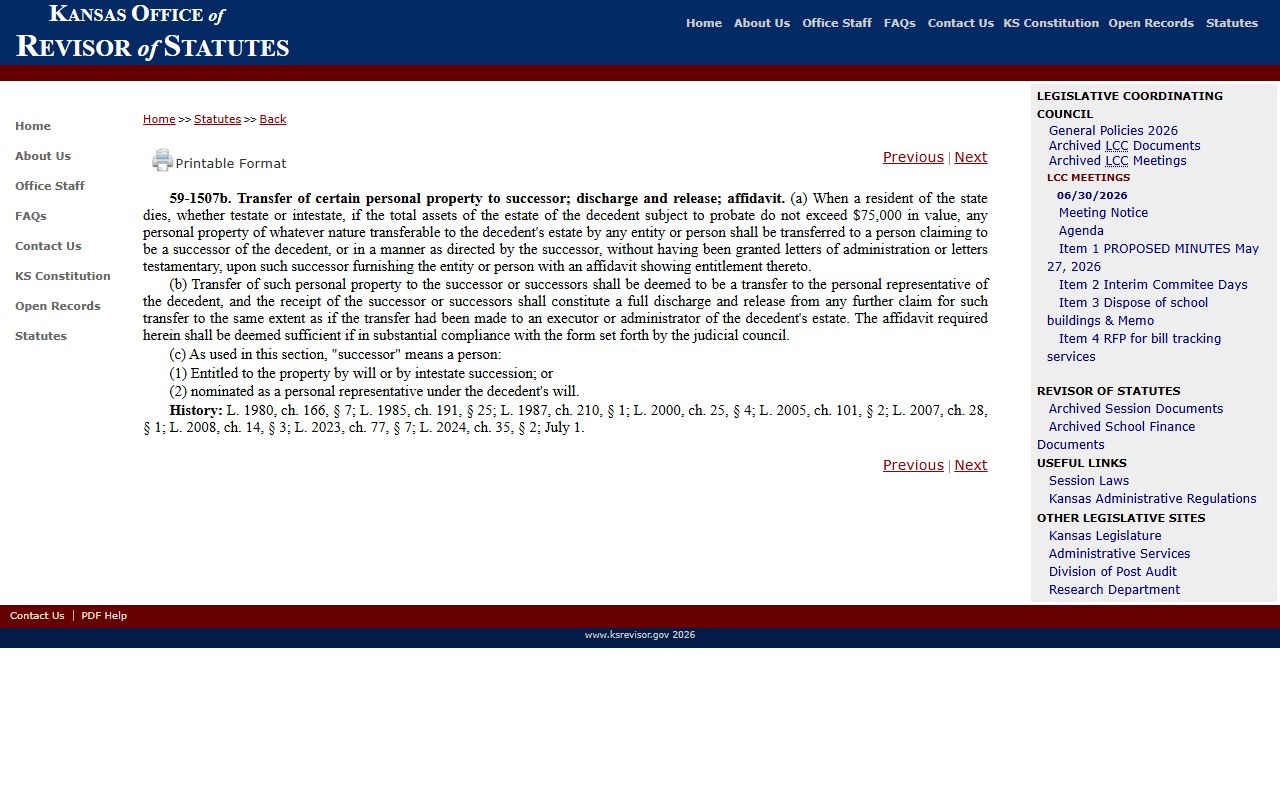
That statute helps identify when a simplified affidavit may fit better than a formal Jewell County probate case.
Jewell County Probate Filing Process
Formal probate starts when the proper petition is filed in District Court. The exact petition depends on whether there is a will, whether a fiduciary needs appointment, whether the case concerns descent, and whether the filing seeks guardianship or conservatorship authority. Once a case opens, notices, hearings, orders, letters, inventories, accountings, and final settlement steps may follow.
- Identify whether the matter is an estate, will, small-estate affidavit issue, guardianship, conservatorship, or determination of descent.
- Select the correct Kansas form or pleading, using official Judicial Council forms where available.
- File the petition or required papers with Jewell County District Court and pay the filing fee or request fee relief if eligible.
- Give required notice to heirs, beneficiaries, creditors, wards, interested persons, or other parties as the case type requires.
- Request certified copies of letters, orders, or decrees from the Clerk of the District Court when banks, title companies, or agencies require proof.
Restricted Probate Records
Probate is generally a public court function, but not every document is open in full. Personal identifiers can be redacted under Kansas court rules. Medical, treatment, financial-account, minor, guardianship, conservatorship, and sealed materials may be limited by statute, rule, or court order. A public docket can show that a case exists while specific documents or details remain unavailable.
For sensitive probate matters, ask the clerk what can be released before ordering copies. If a certified copy is needed for legal or financial use, request the exact order, letters, or decree by name. The clerk can certify public court documents, but the clerk cannot provide legal advice about which filing should be used or whether a person is eligible to act for an estate.