
Jewell County Arrest Records and Charges
Jewell County arrest records document the fact of an arrest or booking through law enforcement. The official sheriff contact is Jewell County Sheriff Don Jacobs, 307 North Commercial, Mankato, KS 66956, phone 785-378-3194. No official Jewell County online jail roster, booking log, or arrest blotter was found in official county sources. That matters because arrest records and court charge records must be checked through different channels.
The court charge record starts when the Jewell County Attorney or prosecutor files charges in District Court. Kansas counties generally use county attorneys for local state prosecutions, and Jewell County's official directory lists Attorney at 785-378-4010. The prosecutor reviews law-enforcement reports, decides whether state charges should be filed, and appears at first appearances, bond hearings, preliminary hearings, pleas, trials, sentencing, probation violation hearings, diversion discussions, and expungement matters.
Booking or custody questions belong with the sheriff or custody tools, while filed court charges belong in Kansas Case Search and District Court records. For current custody paths, use Jewell County inmate records. For the full criminal case file, including plea, disposition, and sentence, use Jewell County criminal court records.
The BIDS contact image assigned to this page comes from the Kansas State Board of Indigents' Defense Services contact page.

That statewide source is relevant when a defendant needs to ask the court about appointed counsel after arrest and before the case moves further.
Search Jewell County Arrest Records
Because no official Jewell County arrest-search portal was found, start with the record type. For booking or custody status, call the sheriff at 785-378-3194 or use Kansas VINE for custody notification. For court charges after arrest, search Kansas Case Search by case number, party name, business name, citation, or available role-based criteria. When the charge does not appear online, contact the Clerk of the District Court at 785-378-4030.
- Use sheriff contact for current booking, custody, bond, surrender, or arrest confirmation questions.
- Use Kansas Case Search for filed District Court charges and charge status after a case opens.
- Search by case number first, then by defendant name or citation if the case number is not known.
- Read each count separately because one arrest can produce several charges with different outcomes.
- Ask the District Court clerk for certified copies or older records that are not visible online.
The KBI criminal-history search at Kansas.gov criminal history is a fee-based statewide repository check. It is not a live booking roster. The KBI Registered Offender Search is also separate. It covers registered sex, violent, and drug offenders under the registration system, not every arrest or charge.
Charges After Arrest Documents
Charges after arrest move from police or sheriff action into court only when a formal charging document is filed. Kansas research for Jewell County highlights K.S.A. 22-2901 and K.S.A. 22-2902 because an arrested person must be brought before a magistrate without unnecessary delay, and felony defendants generally receive a preliminary examination unless the hearing is waived, continued, or replaced by another legal path. The filed accusation becomes part of the court charge record.
| Document | Filed By | What It Does | Where It Appears |
|---|---|---|---|
| Complaint | Prosecutor or authorized charging authority | Starts the criminal accusation and lists charged counts. | District Court case file and docket entries. |
| Information | Prosecutor | States formal charges, often after screening or preliminary proceedings. | Criminal case file, count list, and amended charge entries. |
| Indictment | Grand jury | Charges a case through grand-jury action when used. | District Court file if filed as the charging document. |
The KBI registered-offender image assigned to this page comes from the KBI offender registry.
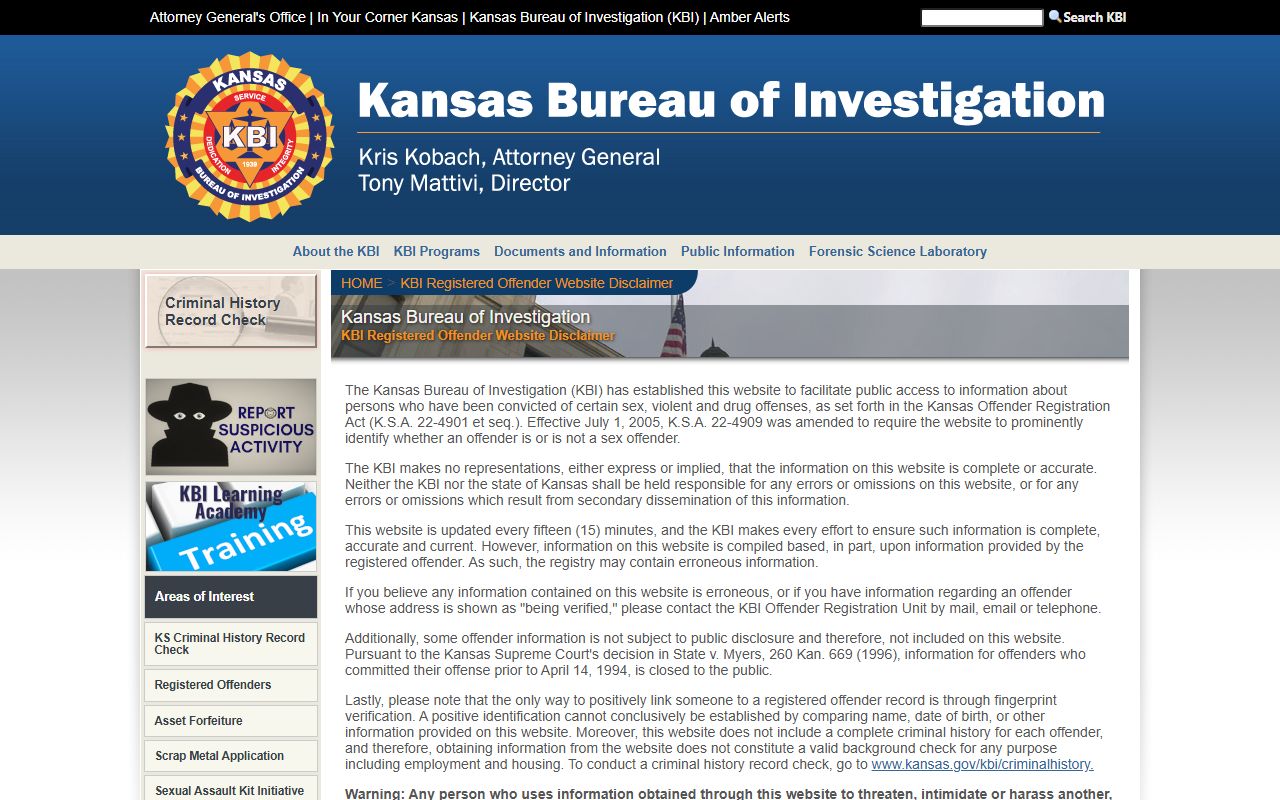
The registry can show registered offender information, but it should not be treated as the place to find every Jewell County arrest or every court charge.
Jewell Charge Status Table
Charge status changes as the case moves. A first charge may not be the final charge. The prosecutor may amend a count, reduce a severity level, dismiss a count, add a count, or resolve one count by plea while another is dropped. That is why the docket and disposition must be read count by count. A single arrest can produce one case, multiple counts, a dismissed case, diversion, or no filed court case at all.
| Status | What It Means | How to Read It |
|---|---|---|
| Pending | The charge is active and has not reached final disposition. | Check future hearings, bond terms, and motion entries. |
| Amended | The filed charge was changed by prosecutor filing or court action. | Compare the old count with the current count before citing it. |
| Reduced | The charge severity or offense was lowered. | Look for plea agreement, amended information, or disposition notes. |
| Dismissed | The court record shows the count or case ended without conviction on that charge. | Check whether dismissal was with or without prejudice if shown. |
| Diversion | The case may be handled under an agreement rather than immediate conviction. | Look for completion, termination, or later expungement issues. |
| Convicted | The court accepted a plea or entered a guilty verdict. | Read the sentence and final judgment for each count. |
Charge vs Conviction
Being charged in Jewell County is not the same as being convicted. A charge is a filed accusation. A conviction is a final court result based on a guilty plea, no contest plea accepted by the court, or guilty verdict. Public records can show both. The risk is reading the first accusation and missing later entries that changed or dismissed it.
| Point | Charge | Conviction |
|---|---|---|
| Record stage | Early or amended accusation. | Final outcome for a count. |
| Proof level | Based on filed allegation and probable cause process. | Based on plea or verdict beyond the normal criminal burden. |
| Can disappear from outcome | Yes, a count may be dismissed or reduced. | Usually remains unless reversed, vacated, expunged, or otherwise changed by order. |
| Best source | Complaint, information, count list, and docket entries. | Disposition, sentence, journal entry, and judgment record. |
Note: A charge list without a matching final disposition is not enough to describe a Jewell County criminal outcome.
Statewide Charge Lookup Limits
Statewide Kansas systems answer different questions. Kansas Case Search is the public District Court case path. KBI criminal history is a fee-based repository check, with the research noting a $30 Kansas.gov purchase price and an unavailable period from midnight to 4 a.m. Central. KBI offender registration is for registered offender status. Kansas VINE and VINELink handle custody status and notification, not a complete charge archive.
For defense access, no Jewell County-specific public defender office page was found. Court-appointed counsel is handled through court and Kansas indigent-defense procedures. The practical local instruction is to ask the judge or court contact about appointed counsel at first appearance or through the District Court. The statewide BIDS administrative office can answer system questions, but it is not listed as a Jewell-specific defender office.
The juvenile-record image comes from K.S.A. 38-2309.
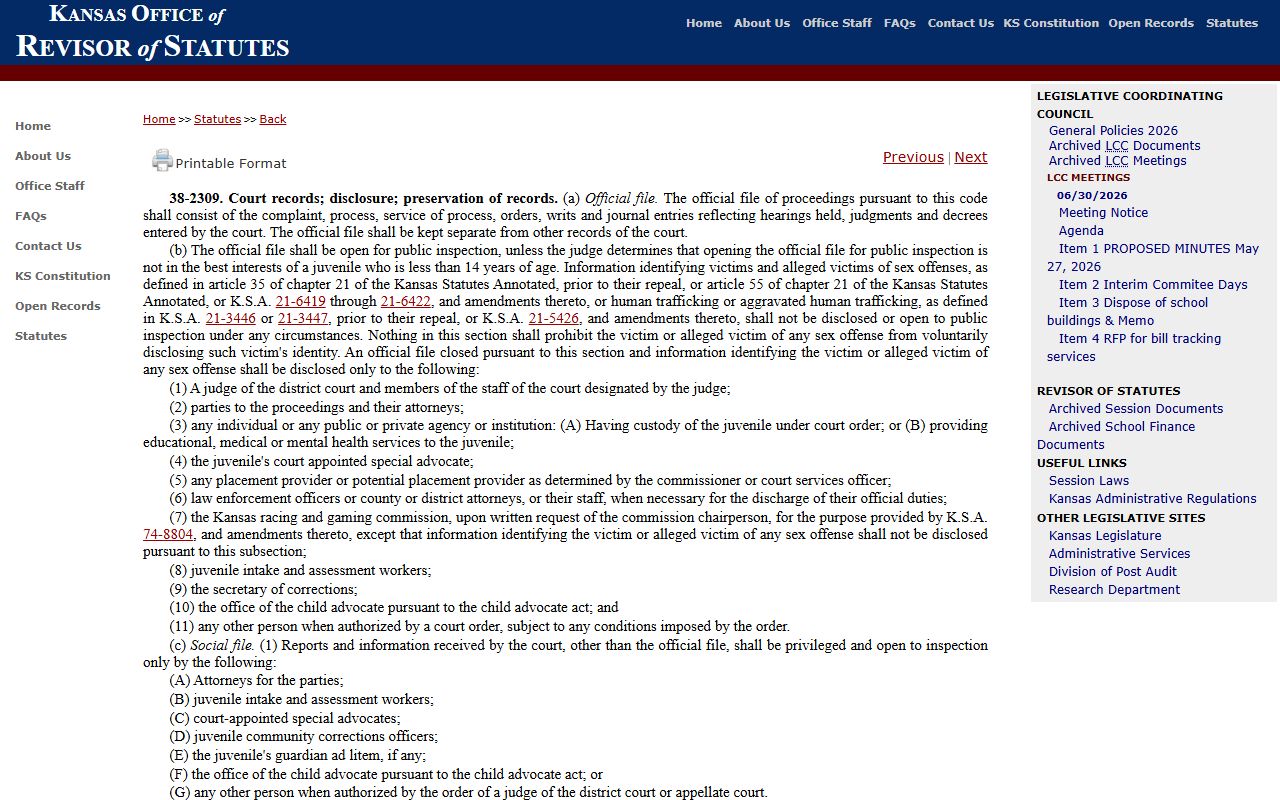
Juvenile charge records need special care because Kansas law does not treat every juvenile file as an ordinary adult arrest or court-charge record.
Jewell Arrest Record Access
Kansas public access is broad but limited. K.S.A. 45-218 recognizes public inspection unless another law closes the record. K.S.A. 45-220 allows agencies to require enough information to identify a record and may allow written request procedures. K.S.A. 45-221 lists records not required to be disclosed. Court records also depend on Kansas Supreme Court public-access rules and Rule 24 protections for personally identifying information.
In practice, ask the sheriff for sheriff-created arrest or booking records, ask the District Court for filed charge documents, and use KBI only when a statewide criminal-history or offender-registry result is the correct record type. Do not rely on private jail-directory sites when official Jewell County sources did not publish a booking database.
Sealed vs Expunged Charges
Sealed and expunged records affect both arrest records and court charges after arrest. A sealed record is closed or limited by law, rule, or court order. An expunged record is restricted through a statutory process. Kansas has separate expungement paths for qualifying arrest records and for certain convictions, arrests, and diversion agreements.
| Point | Sealed | Expunged |
|---|---|---|
| Effect on access | Public access is hidden, narrowed, or redacted. | Ordinary disclosure is limited after a granted petition. |
| Common examples | Juvenile files, protected victim data, sensitive identifiers, treatment records. | Qualifying arrest, conviction, or diversion records under Kansas expungement statutes. |
| Where to start | Ask the court whether an order or statute controls access. | Identify the exact arrest or case and file in the proper District Court. |
| What remains possible | Authorized parties may still have access. | Law-enforcement, licensing, sentencing, registration, and statutory exceptions may still apply. |
Restricted Jewell Charge Records
Restricted charge records include juvenile matters, sealed filings, expunged arrests or cases, protected victim information, personal identifiers, and records tied to active investigations or search warrants. A District Court docket may show a public shell while documents remain unavailable. A sheriff record may also be withheld or redacted if a Kansas exemption applies.
When a requested Jewell County arrest or charge record is not public, ask which office holds it and what rule or order controls access. Court charge copies route through the Clerk of the District Court. Sheriff-created arrest records route through the sheriff. Complete statewide criminal-history checks route through KBI. Those channels should not be merged because each record has a different legal source and update cycle.